Case study
A Rigorous Test for Re-Gen with Stueve Ag
Farmer
Kirk Stueve
Location
Minnesota and Wisconsin
Crop
Corn-on-corn rotation
Application size
140 acres
Seasons
2024 & 2025
Tillage
Minimum tillage, challenges with heavy soil and residue
Observed benefits
+10–20 bu/ac
Yield gain in productive zones
40–50 lb N
Estimated credit per acre
Faster residue breakdown
And cleaner tillage
The challenge
Like many Midwest growers, Kirk Stueve was watching with concern as input costs climbed. Fertilizer prices were rising even as grain prices softened, and he was looking for ways to protect margins without risking yield.
“I’m always trying something new,” Kirk said. “I’m driven by data, and I’m curious. But I’m not going to make a big investment on the farm without statistical evidence that it’s worth it.”
Despite years of trials with leading biological brands, nothing had shown measurable value. “They have excellent marketing and brand recognition,” Kirk said of the biologicals he’d tried. “But we never saw enough increase in yield to justify the cost.”
So when he heard about IMIO Re-Gen, Kirk was both skeptical and intrigued. The company’s focus on hard science and real data stood out. “Most of the market doesn’t have that baseline where science and data drive the direction of the company,” he said.
The approach
Kirk runs a family operation in western Minnesota, where heavy soils make full no-till difficult. He uses a minimum-till system, leaving 40–50% residue to preserve soil health while ensuring spring fields warm and dry efficiently.
His Re-Gen trial in 2024 was deliberately rigorous.
“Whenever we trial products on the farm, it’s not a side-by-side visual comparison. It’s a fully randomized block design so we can pull out statistically defensible results to determine whether it worked and whether it was profitable.”
He applied Re-Gen to a 140-acre field in a corn-on-corn rotation, about three weeks before planting. Mixing and application were straightforward.
“It was smooth and seamless—no different than a standard herbicide or fungicide pass,” he said.
The only drawback? Re-Gen is tank-compatible with some, but not all, commonly used herbicides. For Kirk, this meant applying Re-Gen required an extra pass across the field. “That’s an extra expense—maybe eight to twelve dollars an acre,” Kirk noted.
“If we can mix it with another pass, that’d be ideal. But it was worth it to see how the product performed.”
Early observations
The first few weeks didn’t show much. But as the season progressed, Kirk noticed that there was a visible difference in how the stalks were breaking down. “Anecdotally, it looked like they were breaking down faster where Re-Gen was applied,” he said.
Still, the real story came from the sky.
“Standing on the ground, it was very difficult to see differences. We couldn’t pull it out with the human eye. But the satellite imagery told a different story.”
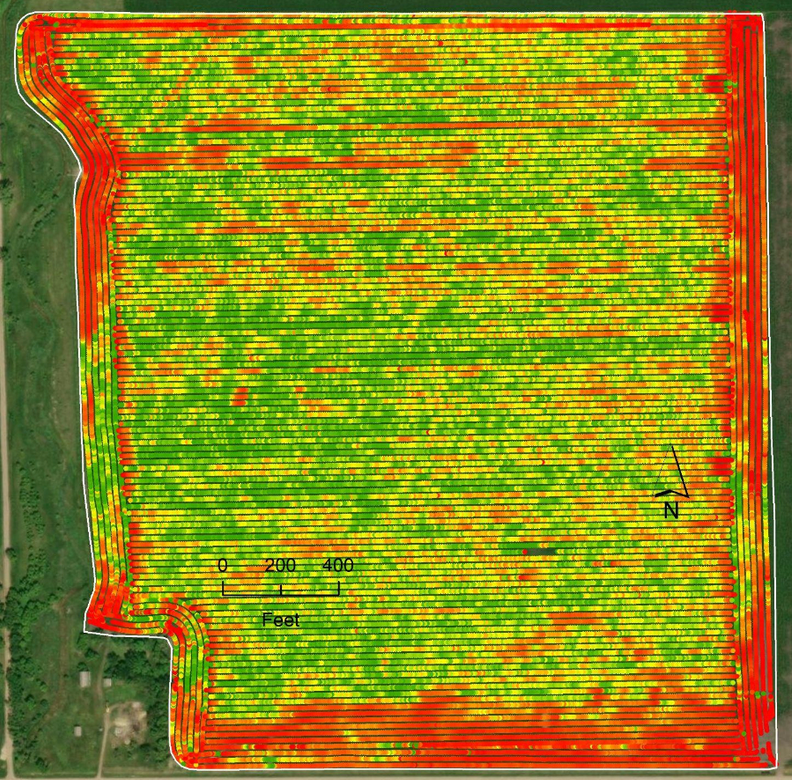
Using NDVI and red-edge indices from Sentinel-2 satellite data, he saw clear signs of higher crop vigor in Re-Gen-treated areas beginning in July and August. “Those values started ticking higher where Re-Gen was applied and lagged behind in the control,” he said. “This is an excellent early indicator that something might be happening to boost yields.”
Results
At harvest, the yield data supported what the satellites saw.
“Overall, there was a nice benefit and boost in yield,” Kirk said. “On the most productive parts of the field, we saw 10–20 bushels per acre higher yields compared to control.”
At an illustrative corn price of $5 per bushel, that yield gain represents additional gross revenue before product and application costs. But Kirk also saw benefits when cutting back on synthetic nitrogen.
“We reduced nitrogen in some test blocks and still saw equivalent yields. It looked like a 40–50-pound nitrogen credit where Re-Gen was applied.”
After harvest, he noticed the treated blocks working up cleaner. “The stalks broke down easier, the soil had better tilth—it just worked up nicer,” he said.

The verdict
Today, Kirk describes Re-Gen as a standout among biologicals.
“From what I’ve seen so far, it’s an outlier,” he said. “It’s made me more optimistic about the potential value biologicals can provide.”
He has also come to value the partnership with IMIO’s team.
“They’re with us every step of the way, helping with interpretation, offering insights, listening to our concerns. Most companies just want to sell product. IMIO actually cares about helping us make money while improving soil health.”
Encouraged by the 2024 results, Kirk replicated the trial in 2025—this time under wetter conditions. Despite the challenges, the trends held.
“From what I’ve seen so far,” Kirk said, “it’s enough to put Re-Gen in a place where it has high potential to get rolled out across the farm.”